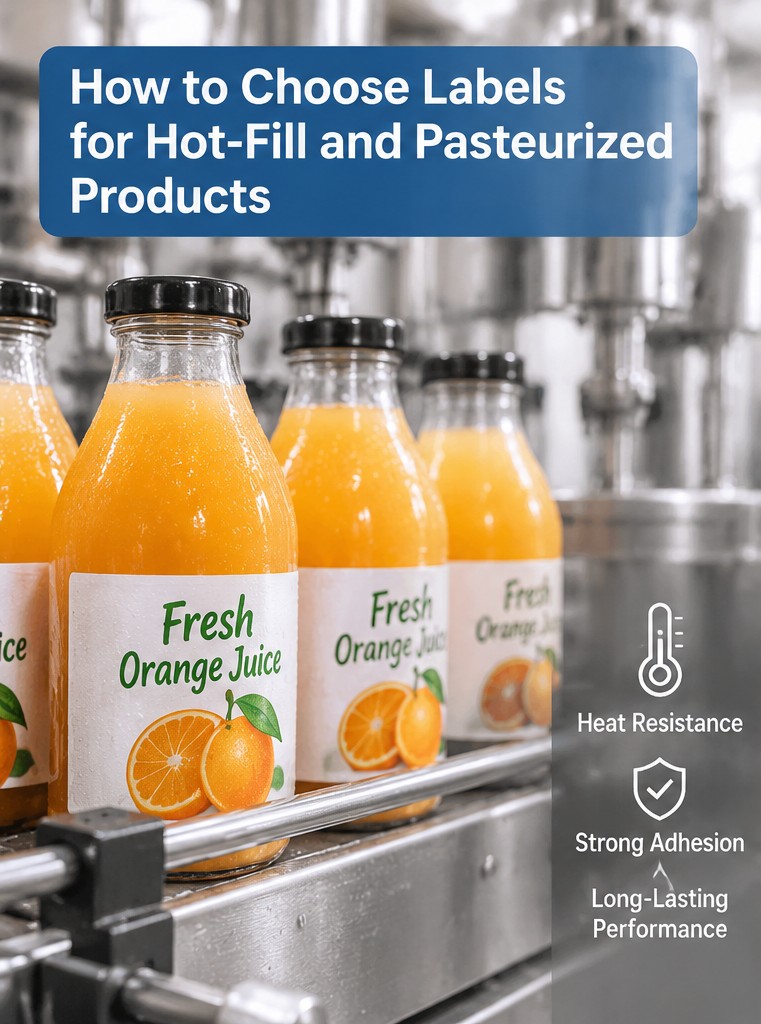
Hot-fill and pasteurization are common processing methods in the food and beverage industry. They help extend product shelf life and maintain product safety. However, these processes can create challenges for product labels, especially when containers are exposed to elevated temperatures, moisture, condensation, or rapid temperature changes.
Choosing the right label is important to ensure that packaging maintains its appearance and performance throughout production, storage, transportation, and distribution.
In this article, we will explore the key factors to consider when selecting labels for hot-fill and pasteurized products.
1. Understand the Temperature Conditions
Before selecting label materials, it is important to understand the actual temperature conditions during product processing.
Hot-fill products are typically filled into containers at elevated temperatures. Depending on the product and process, the container may remain hot for a period of time before cooling.
Pasteurization involves controlled heating to reduce microorganisms. The temperature, duration, and processing environment vary depending on the product and production method.
These conditions can affect label materials in different ways:
- Heat Exposure: High temperatures may cause adhesive performance to change or affect the appearance of certain label materials.
- Moisture and Condensation: Cooling processes may create moisture on the container surface, affecting label adhesion.
- Temperature Changes: Rapid transitions between hot and cold environments can put additional stress on the adhesive bond.
- Mechanical Handling: Labels may experience friction or pressure during filling, packaging, and transportation.
Therefore, the actual processing temperature, exposure time, and application conditions should be confirmed before choosing a label solution.
2. Select the Right Label Face Material
The face material directly affects the label's appearance, durability, and resistance to environmental conditions.
Different materials offer different advantages depending on the packaging type and application requirements.
Coated Paper Labels
Coated paper labels are commonly used for food and beverage packaging. They provide a smooth printing surface and are suitable for detailed graphics, product information, and brand designs.
However, standard paper labels may not be suitable for applications involving prolonged moisture exposure or demanding temperature conditions. A suitable coating and adhesive system should be selected according to the actual environment.
BOPP Film Labels
BOPP (Biaxially Oriented Polypropylene) is a popular material for beverage and food packaging.
Its main advantages include:
- Good moisture resistance
- Good dimensional stability under suitable application conditions
- Smooth printing surface
- Options for transparent, white, and metallic finishes
BOPP film labels are often considered for bottles and containers that require moisture resistance. However, heat resistance depends on the specific film grade, printing system, and adhesive construction.
PET Film Labels
PET labels offer good dimensional stability and mechanical durability. They can be considered for applications requiring greater resistance to handling and environmental changes.
The suitability of PET labels for hot-fill or pasteurization processes still needs to be verified based on the specific material construction and processing conditions.
3. Choose an Adhesive Designed for the Application
The adhesive is one of the most important components of a label used in hot-fill and pasteurized products.
Even when the face material performs well, an unsuitable adhesive may cause lifting, edge curling, slipping, or complete label detachment.
Consider the following factors:
- Application Temperature: Determine whether labels will be applied to hot, warm, or fully cooled containers.
- Service Temperature: Confirm the temperature the label will experience after application.
- Surface Material: Glass, PET, HDPE, and other packaging materials may require different adhesive formulations.
- Surface Condition: Moisture, condensation, oil, and dust can reduce adhesion.
- Cooling Process: Check whether the adhesive can maintain bonding performance during temperature changes.
It is important to distinguish between application temperature and service temperature. An adhesive that performs well during normal room-temperature application may not necessarily be suitable for a hot container or subsequent pasteurization process.
For demanding applications, the complete label construction should be tested under actual production conditions.
4. Pay Attention to Printing Inks and Surface Finishes
Label performance is not determined by the adhesive and face material alone. Printing inks, varnishes, and other surface finishes also need to be considered.
For example, certain coatings may soften, discolor, or lose their appearance when exposed to elevated temperatures or moisture.
When selecting printing finishes, consider:
- Printing Ink Resistance: Check whether the ink can maintain its color and adhesion during the required processing conditions.
- Varnish Performance: Confirm whether the selected gloss or matte varnish is suitable for the expected temperature and moisture exposure.
- Color Stability: Evaluate whether the printed colors remain consistent after processing.
- Surface Protection: Consider suitable protective coatings when additional resistance to abrasion or handling is required.
Hot stamping, UV coating, and other decorative effects may also be used, but their suitability should be evaluated individually.
A visually attractive label should also meet the functional requirements of the packaging process.
5. Test Labels Under Actual Processing Conditions
Material specifications are useful when selecting labels, but laboratory data alone may not fully represent real production conditions.
Before placing a large order, it is recommended to conduct application and performance tests using the actual container, product, and processing equipment.
Important tests may include:
- Adhesion Testing: Check whether the label remains firmly attached to the container.
- Heat Resistance Testing: Evaluate changes in adhesion and appearance after exposure to the required temperature.
- Water and Condensation Testing: Check for edge lifting, wrinkling, or other defects after cooling.
- Scratch and Abrasion Testing: Evaluate whether the printed surface can withstand normal handling.
- Visual Inspection: Check for discoloration, deformation, bubbles, and changes in label appearance.
Testing should reproduce the actual processing temperature, exposure time, cooling conditions, and application sequence as closely as possible.
6. Work with a Label Manufacturer Early
Choosing a label for hot-fill or pasteurized products requires more than simply selecting a waterproof material.
The label manufacturer should understand the product's packaging structure, processing conditions, application method, and storage environment.
When requesting a quotation, it is helpful to provide:
- Container material and shape
- Label dimensions and artwork
- Expected production quantity
- Filling or pasteurization temperature
- Processing duration
- Whether labels are applied before or after heating
- Storage and transportation conditions
With this information, the manufacturer can recommend a more suitable combination of face material, adhesive, printing ink, and surface finish.
Why Choose Jinke Label?
At Jinke Label, we provide custom self-adhesive label printing solutions for food, beverage, cosmetics, and other industries.
We offer various label materials, including coated paper, synthetic paper, BOPP, PE, PET, and other film materials. Different printing and finishing options are available to meet packaging requirements.
For applications involving heat, moisture, or other demanding conditions, we can discuss the application environment and recommend suitable material combinations for evaluation.
Our quality inspection process includes adhesion, peel, temperature, scratch, and other performance checks according to product requirements.
If you are developing labels for hot-fill or pasteurized products, contact Jinke Label with your packaging details. Our team will help you evaluate suitable label options for your application.


 Español




 Sales Executive