Los envases de plástico HDPE y PP se utilizan ampliamente en industrias como la cosmética, los productos químicos para el hogar, el cuidado personal y los productos industriales. Sin embargo, muchos fabricantes experimentan problemas al aplicar etiquetas a estas superficies.
Los problemas comunes incluyen:
- Las etiquetas se están despegando.
- Adhesión inicial deficiente
- Elevación de bordes
- Las etiquetas se desprendieron durante el transporte.
La razón suele estar relacionada con las características de los materiales HDPE y PP.
¿Por qué resulta difícil etiquetar las botellas de HDPE y PP?
A diferencia del vidrio o el PET, los plásticos HDPE y PP tienen una baja energía superficial, lo que dificulta que los adhesivos creen una unión fuerte.
Baja energía superficial significa:
- El adhesivo no se puede extender de manera uniforme.
- Se reduce el área de contacto entre el adhesivo y el recipiente.
- La fuerza de unión puede ser más débil.
Por lo tanto, el uso de un adhesivo estándar puede provocar que la etiqueta falle.
Problemas comunes en el etiquetado de envases de HDPE y PP
1. Las etiquetas se despegan después de la aplicación.
Esto suele ocurrir cuando:
- El adhesivo no es apto para superficies de plástico.
- La superficie del contenedor está contaminada.
- La etiqueta se aplica en condiciones inadecuadas.
Solución:
Utilice adhesivos diseñados específicamente para superficies plásticas de baja energía.
2. Levantamiento de bordes en botellas curvas
Los envases de HDPE y PP suelen ser flexibles y curvos.
Durante su uso, el envase puede comprimirse o deformarse, lo que provoca tensión en los bordes de la etiqueta.
Solución:
Elegir:
- Materiales de etiquetas flexibles
- Adhesivos fuertes y permanentes
- Materiales adecuados para superficies curvas
3. Mala adhesión debido a la contaminación de la superficie.
Muchos productos contienen:
- Aceite
- Humedad
- productos químicos
Esto puede reducir el rendimiento del adhesivo.
Solución:
Considerar:
- Adhesivo resistente al aceite
- Limpieza adecuada de la superficie
- Materiales de etiquetado adecuados
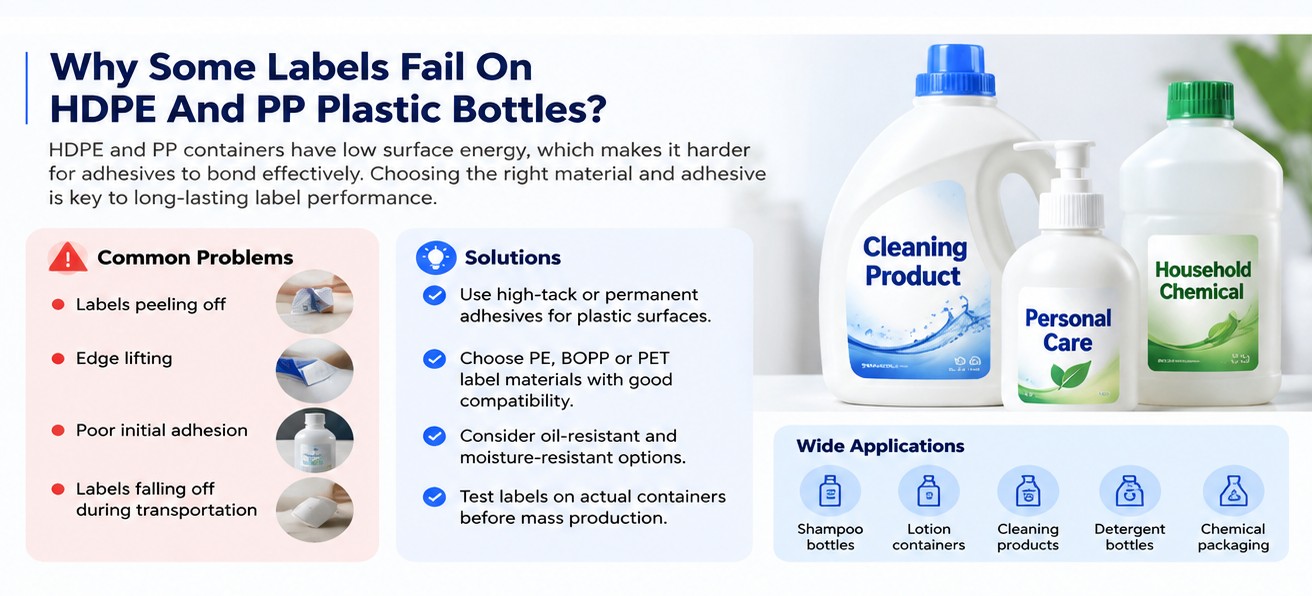
¿Cómo elegir las etiquetas adecuadas para botellas de HDPE y PP?
1. Seleccione el adhesivo correcto.
Para envases de HDPE y PP, las opciones recomendadas incluyen:
- Adhesivo de alta adherencia
- Adhesivo permanente para superficies plásticas
- Adhesivos especiales para materiales de baja energía superficial.
2. Elija materiales de etiquetas adecuados.
Las opciones más comunes incluyen:
Etiquetas de PE
Ventajas:
- Flexible
- Adecuado para envases exprimibles
- Buena compatibilidad con envases de plástico.
Etiquetas BOPP
Ventajas:
- Impermeable
- Durable
- Adecuado para productos de cuidado personal y del hogar.
Etiquetas de PET
Ventajas:
- Aspecto de primera calidad
- Excelente durabilidad
- Adecuado para envases de alta gama.
3. Considere las condiciones de aplicación.
Antes de la producción, tenga en cuenta lo siguiente:
- Etiquetado manual o automático
- Velocidad de etiquetado
- Temperatura de almacenamiento
- Entorno del producto
Se recomienda encarecidamente probar las etiquetas en envases reales antes de la producción en masa.
Aplicaciones que utilizan etiquetas de HDPE y PP
Las aplicaciones comunes incluyen:
- Botellas de champú
- Envases de loción
- Productos de limpieza
- Botellas de detergente
- Envases de productos químicos
- productos de cuidado personal
Conclusión
Los fallos en el etiquetado de los envases de HDPE y PP suelen deberse a una selección incorrecta del material o del adhesivo, más que a la etiqueta en sí.
Elegir la combinación adecuada de material para la etiqueta y adhesivo puede mejorar la durabilidad, la apariencia y la eficiencia de la producción.
En Jinke Label, ofrecemos soluciones de etiquetado personalizadas para aplicaciones de embalaje exigentes, incluyendo envases de plástico de bajo consumo energético, etiquetas impermeables, etiquetas resistentes al aceite y superficies de embalaje flexibles.
Contáctanos para encontrar la solución de etiquetado adecuada para tus productos.


 Español




 Sales Executive